By Ashoak Lakhaney, Founder & Chief Geek, Techality
Robotics and automation are no longer technologies designed only for manufacturing and fulfilment centres. As the technologies become more affordable, capable and accessible, their application is extending into an increasing number of sectors, including hospitality, facilities management and foodservice/contract catering.
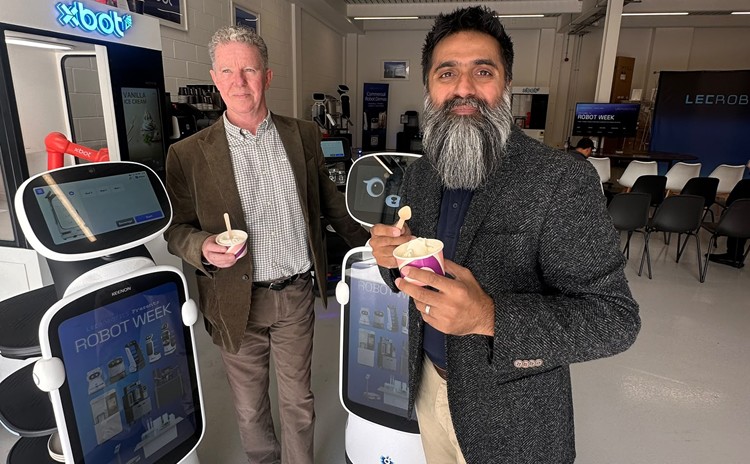
Last week I visited a distributor hosting “Robot Week“. When I told my children where I was going, the look on their faces was priceless. To them, robots still belong in films and computer games. What I saw, however, was technology already finding its way into real operational environments.
The event provided an opportunity to see first-hand the pace at which robotics is developing across multiple industries. From cleaning and food production to service, logistics and delivery, the technology on display demonstrated just how far robotics has evolved in recent years.
However, while the technological capability is impressive, the most important question for hospitality operators is not what these robots can do. It is whether they represent an additional cost or a genuine investment.
Technology Must Solve Real Problems
Hospitality has never lacked innovation. The industry has seen the introduction of everything from self-service kiosks and AI-powered ordering systems to automated stock management and digital payment solutions. Some have been transformative for the operations and customer experience, whilst others have struggled to gain widespread adoption, and everything in between.
The difference is often quite simple, successful technologies address and genuinely add value. The same principle applies to robotics. For operators evaluating new technologies, questions around return on investment, practicality, reliability and scalability remain far more important than technical specifications.
A robotic solution may be capable of performing a task, but can it perform that task consistently, economically and in a way that delivers measurable value to the business. I am still very much sat firmly on the fence. I say that as with the vast range of contract catering and facilities sites that truly are diverse, what is value to one operation is a ‘dust gatherer’ in another.
Replacing Labour or Addressing Labour Shortages?
One of the most debated aspects of robotics and in that fact a lot of technology introduction and implementation is the impact on employment. The hospitality industry has, quite rightly, been traditionally built around people, with service and human interaction remaining central to the customer experience. However, labour shortages continue to affect much of the industry, particularly in operational and support roles.
The challenge facing hospitality is well documented. Office for National Data regularly shows hospitality businesses continue to be among those most likely to struggle filling vacancies, while employee turnover remains amongst the highest of any UK sector. Against that backdrop, the conversation around robotics becomes less about replacing employees and more about supporting businesses that simply cannot recruit enough people to meet demand.
This raises an important distinction. For many organisations, robotics is not necessarily about replacing existing employees. Instead, it may be about supporting operations where recruitment remains difficult or where repetitive tasks place increasing pressure on already stretched teams.
Viewed through this lens, robotics becomes less about workforce reduction and more about workforce support. The train of thought then changes from replacing people to enabling people to focus on higher value activities.
On the drive back home from the event, I called the Managing Director of a prominent caterer to bounce ideas around. My own view remained sceptical because of the ethical questions around labour and automation. His response was immediate. The challenge, he argued, is not replacing people. The challenge is finding them in the first place. It was a powerful reminder that the robotics debate often looks very different from the operator’s perspective dealing with the issues in real time.
Hospitality Is Not One Industry
One of the challenges in assessing the role of robotics within contract catering is the sheer diversity of environments in which operators work.
Contract catering encompasses:
- Business & Industry
- Education
- Healthcare
- Distribution and logistics centres
- Sporting venues and stadia
- Leisure and entertainment venues
- Corporate headquarters…..and more
Each brings different customer expectations, operational requirements and service models. A solution that proves highly effective in a large-scale distribution environment may offer limited practical benefit in a private school dining environment.
Similarly, technology that supports high-volume foodservice operations in a stadium may not provide a compelling business case within a smaller corporate restaurant.
As a result, there is unlikely to be a single robotics solution that suits every sector. Adoption will almost certainly be driven by individual operational challenges and site-specific requirements.
The use case must be proven. The benefits must be evidenced. And the solution must be relevant to the operating environment.
Are there opportunities – yes. Are they universal – no.
The Importance of the Business Case
As robotics continues to evolve, the commercial case will ultimately determine the speed of adoption.
Operators will naturally assess:
- Capital investment requirements
- Ongoing maintenance costs
- Reliability and support
- Operational efficiencies
- Impact on customer experience
- Return on investment
The hospitality industry has historically been pragmatic in its approach to technology investment. Decisions tend to be driven less by innovation itself and more by measurable operational outcomes. This is unlikely to change, and nor should it. But I think the measurable operational outcomes need to be more strategic at corporate level rather than just tactical at site or contract level.
One of the challenges with robotics in contract catering is that the decision does not always sit with the operator. Unlike purchasing a coffee machine, dishwasher or EPOS system, robotics may require buy-in from clients, facilities teams, procurement functions, landlords and wider corporate stakeholders.
Many contract caterers operate within environments they do not own. As a result, the business case has to extend beyond labour savings on a single contract and demonstrate wider organisational value, whether that is productivity, consistency, sustainability, health and safety improvements, employee experience or access to operational data.
Perhaps the biggest challenge for vendors is understanding that hospitality operators rarely work in isolation. A robotics deployment may require alignment between multiple stakeholders before a single unit ever reaches site.
For that reason, robotics cannot simply be justified as a site-level labour-saving exercise. The strongest business cases are likely to be those that align with wider corporate objectives and estate-wide strategies.
A Future Alongside People, Not Instead of Them
Perhaps the most significant observation from Robot Week was not the capability of the technology itself, but the increasing maturity of the conversations surrounding it. The debate is moving beyond whether robots can carry out certain tasks. Instead, it is becoming focused on where automation can create the greatest value while preserving the qualities that make hospitality unique.
For all the advances being made in robotics and artificial intelligence, hospitality remains fundamentally a people business. Service, empathy, relationships and human interaction continue to be critical differentiators.
The most successful applications of robotics are therefore likely to be those that complement human teams rather than attempt to replace them.
There is little doubt that robotics will become increasingly visible across many industries in the coming years. Whether adoption in hospitality accelerates at the same pace remains to be seen. What is clear is that operators will continue to evaluate these technologies through a simple commercial lens, do they solve a real problem, and do they do so better than existing alternatives?
The technology is becoming ready. The question is not whether robotics is coming to hospitality. The question is whether it genuinely adds value. And perhaps more importantly, whether we as an industry are ready to recognise the potential value and embrace it.
As with every major technology shift before it, the organisations that succeed are unlikely to be those that adopt robotics first, but those that adopt it for the right reasons.