As statutory wages rise and vacancies decline, hospitality businesses have an opportunity to reconsider the economics of employment. Central to that opportunity is company culture and its influence on the retention of experienced people.
Hospitality businesses invest considerable resources in creating environments that encourage guests to return. Applying the same commercial thinking to creating working environments that encourage employees to stay could deliver equally valuable returns.
Perhaps the most significant influence on employee retention within an employer’s control is company culture.
Research published by MIT Sloan Management Review in 2022, examining employee departures across 500 US companies, identified toxic corporate culture as the strongest predictor of employee attrition relative to industry averages, with approximately ten times the predictive power of compensation.
Whilst the research was conducted across multiple industries during a particularly turbulent period in the labour market, its findings warrant attention from hospitality business leaders.
A review of employee turnover research published in the International Hospitality Review reinforces the importance of management behaviour, relationships between colleagues and the quality of the working environment in influencing employees’ decisions to remain with an employer.
How people are treated, valued, recognised and encouraged to develop professionally are all expressions of company culture. So too are the behaviours that management chooses to tolerate.
The commercial significance of company culture becomes increasingly apparent when viewed alongside two developments in the UK labour market.
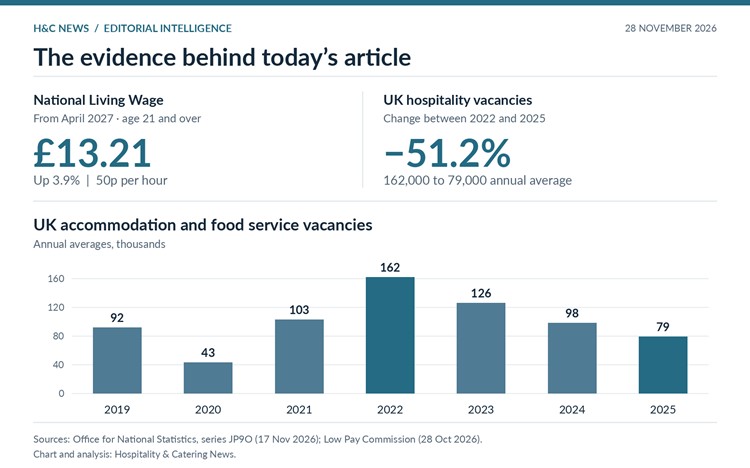
The Low Pay Commission’s announcement on 28 October 2026 confirmed that the National Living Wage will increase from £12.71 to £13.21 in April 2027, a rise of 3.9%.
Meanwhile, Office for National Statistics data published on 17 November 2026 estimated that UK vacancies fell to 690,000 between August and October, a reduction of 22,000 compared with the preceding three-month period.
The longer-term picture within hospitality is particularly revealing. ONS historical vacancy data for accommodation and food service activities records an annual average of 162,000 vacancies in 2022, falling to 79,000 in 2025, below the 92,000 recorded in 2019.
Declining vacancies can reflect easing recruitment pressures, but also weaker demand, constrained budgets and businesses operating with fewer people.
With statutory employment costs increasing, there is a compelling reason to direct more management attention towards retention.
Consider a hospitality business employing 100 people, each working 37.5 hours a week at the National Living Wage. The forthcoming 50p hourly increase would add £97,500 to its annual gross wage bill, before additional employer costs.
That is a clearly identifiable expense, easily incorporated into a financial forecast.
Less readily identifiable is the cost of repeatedly replacing employees. Recruitment expenditure, induction, training, management time, temporary staffing and reduced productivity during the early stages of employment can sit across multiple departmental budgets.
An illustrative business experiencing 60 employee departures annually, with an assumed replacement cost of £3,000 per departure, would incur £180,000 in associated costs. Reducing those departures to 40 could avoid £60,000 in costs, subject to how much of that expenditure is genuinely recoverable.
These are illustrative calculations rather than industry averages, but they demonstrate how improvements in company culture, where they lead to higher retention, could deliver measurable financial returns.
There is also a commercial dimension that extends beyond expenditure. An experienced receptionist who recognises returning guests, a restaurant employee who understands individual dietary requirements, or a kitchen porter who anticipates the demands of a busy service contributes operational knowledge accumulated over time.
When these people leave, some of that knowledge leaves with them.
Earlier this week, H&C News reported on Springboard’s ambition to deliver one million hospitality skills by 2030. Among the figures published alongside its new identity was an employment retention rate of 86% after 12 months among its trainees.
That figure merits attention from finance directors as well as human resources professionals.
Recruitment pathways that reach people previously excluded from employment, including people living with disability, may present commercially valuable opportunities. Realising those opportunities requires a company culture in which people from different backgrounds can contribute, develop professionally and feel valued.
Hospitality businesses routinely measure revenue per available room, average transaction values, food costs and labour as a percentage of turnover.
Alongside these established metrics, employee retention and the annual cost of employee turnover could become equally useful management indicators.
Measuring retention across individual hotels, restaurants, departments and management teams could also reveal differences in workplace culture within the same business, helping identify where effective management practices are delivering commercial returns.
Competitive pay, appropriate staffing levels and effective performance management remain essential. Retention alone cannot establish the quality of a company’s culture, but considered alongside employee feedback and operational performance, it could provide a valuable indication.
Hospitality has long recognised the commercial value of returning guests. Perhaps it is time to apply the same financial rigour to understanding the value of a company culture that encourages employees to return year after year.
Original Editorial – Copyright Notice
This article is original editorial content published by Hospitality & Catering News (H&C News). All rights reserved. References and citations acknowledging H&C News as the original source are welcomed. Except as permitted by law, reproduction, republication, syndication or other commercial exploitation of this content requires prior written permission from H&C News.